CHANGE
v. to make radically different
n. a fresh set of clothing; money

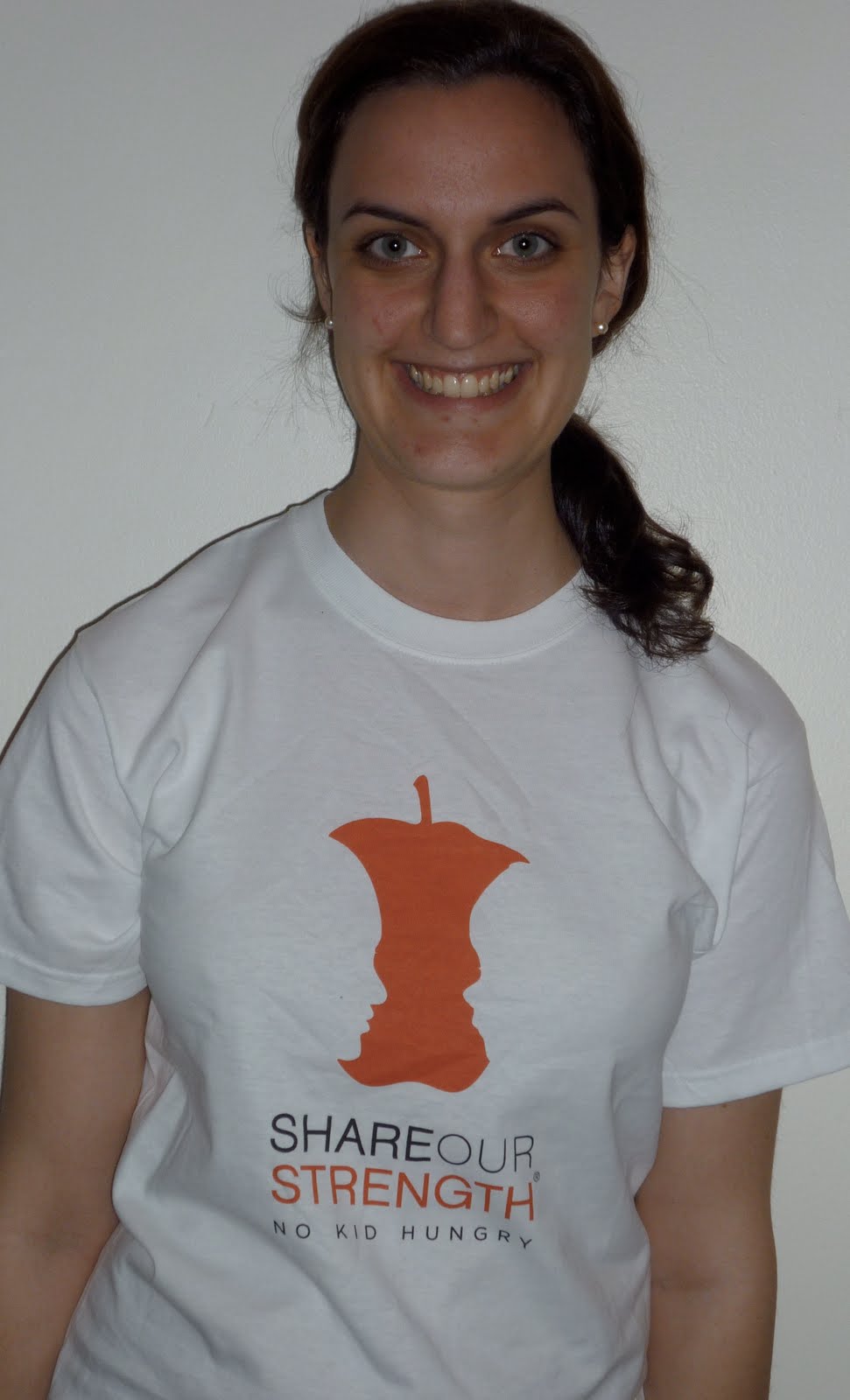
Change t-shirts 52 times in 2010 to raise awareness and funds for 52 world changers.

What do you change for?


Wednesday, April 14, 2010

SHARE OUR STRENGTH


SOS—Help!

While some may think the SOS international Morse code distress signal has become obsolete in our technologically advanced society, the people at Share Our Strength (SOS) are answering calls for help and aid to ensure that “No Kid [goes] Hungry” in America.

SOS uses innovative programming, creative marketing, and intriguing partnerships to integrate healthy nutritional eating habits into the busy lives of hungry children. From the most developed nations to third world countries, hunger rests on every nation’s doorstep.

Almost 1 in 4 children in America (about 17 million kids) is hungry.

We often think of hunger’s immediate effects—growling stomachs or perhaps a headache. But SOS has highlighted hunger’s long term effects, which include weak immune systems, behavioral difficulties, and deteriorating academic performance, among other consequences.

By collaborating and partnering with restaurants and foodservice professionals, SOS has shared the industry’s strength of food knowledge to raise awareness about hunger through cooking classes, volunteering, and fundraising events.

Much of SOS’ success comes from their partnerships with world renowned chefs, restaurants, and corporate sponsorships. From their first
“Taste of the Nation” (an American Express sponsored event where restaurants host tastings to benefit SOS) in 1988, involving 25 cities and raising $250,000, to the current “Taste of the Nation” which includes 55 cities and has since raised over $70 million, SOS has reached millions of lives and continues to promote and expand their mission.

The $265 million raised from SOS’ four main events: “Taste of the Nation,” “Great American Bake Sale,” “Great American Dine Out,” and “A Tasteful Pursuit” is allocated into grants for SOS’ partners and for their own educational program “Operation Frontline,” which teaches low-income families “how to shop for and prepare healthy, low cost meals.”

These grants focus on state partnerships and individual organizations whose work aligns SOS’ 10 points national plan to end childhood hunger. SOS’ Funds and partnerships have already helped to serve 40.2 million meals to kids, created almost 1,000 afterschool feeding facilities, and educated hundreds of thousands about healthy foods.

While many of us living in one of the wealthiest countries in the world rarely think about where our next meal will come from, there are millions of Americans wondering how they will make it through afternoon recess without their snack.

SOS is their help.

Please visit strength.org to find out more.

(Share Our Strength has been feeding the hungry and teaching the importance of nutrition not only in America, but in Ethiopia, Mexico, El Salvador and Haiti as well.)

Wednesday, April 7, 2010

THE DIZZY FEET FOUNDATION


So You Think You Can....

DANCE!


Yes, So You Think You Can Dance (SYTYCD) has made it to charity change. In the summer of 2009, Nigel Lythgoe, the executive producer of SYTYCD, launched The Dizzy Feet Foundation. Partnering with other star choreographers, including Adam Shankman and Carrie Ann Inaba; and star performer, Katie Holmes, Lythgoe has formed a new creative dance venture.


The Dizzy Feet Foundation hopes to impact the dance world in three major ways:


1. Supply scholarships to students studying dance


2. Institute standards for dance education “and an accreditation program for dance schools in all of the major styles of dance”


3. Expand and create dance education programs for disadvantaged children

Fame in the dance-world usually remains as fame in the dance-world. Pop culture does not often tap into the talent among those who leap and chasse across the floor. Rather those spotted on red carpet premieres claim the fame of the public’s eye.

With his immense knowledge of who’s who in the dance world, Nigel Lythgoe along with Katie Holmes, a red carpet star, have taken advantage of their popularity. They have used their own fame as well as the hit show SYTYCD as a platform to launch The Dizzy Feet Foundation. The foundation’s success is built in the popularity that accompanies this fame. After all, who doesn’t love to be a part of a popular movement?


The Dizzy Feet Foundation is currently providing scholarships to nine dancers in dance academies across the U.S. It has also partnered with local community organizations, including LA’s Best, an organization dedicated to enriching after school programming for the most vulnerable in Los Angeles, to bring the joy of dance to people of all backgrounds.


Lythgoe and Holmes, along with the support of major choreographers in contemporary dance, are making dance accessible.

Humans have a spirit of freedom—albeit some more talented than others—to move.


It’s simple—just ask kindergartner Julian why he loves to dance: “I like to move it, move it.”

Please visit dizzyfeetfoundation.org to learn more.

(The Dizzy Feet Foundation is dedicated to improving and expanding access to dance education.)

Thursday, April 1, 2010

ONE DAY'S WAGES


Have you ever calculated your daily wages?

Well, Eugene and Minhee Cho have done exactly that and have formed a global movement out of their calculations. In their quest of ending extreme global poverty, the Chos donated their 2009 income to combat global poverty.

But they didn’t stop there.

They created One Day's Wages (ODW), an organization dedicated to ending extreme global poverty by partnering with existing organizations to raise funds to aid their work. This movement encourages individuals to be conscious of their own daily earnings by donating small amounts to their ODW’s partner’s work. ODW works with non-profit organizations including charity:water, Partners in Health, Heal Africa, and Not for Sale, among others, to raise funds to aid those suffering in extreme global poverty.

Kate, ODW’s operations director, changes for ODW “because it invites people to give what they can, as they’re able. It’s the knowledge and awareness that even small amounts of money can go far in the fight against extreme poverty.”

ODW has reframed the notion of giving.

As Kate mentioned, ODW illustrates the power one individual has to impact the large fight against global poverty. In dedicating just one day’s wages, whatever your salary may be, you become conscious of your earnings and the impact just one day’s work can have in helping to save another’s life.

“3 billion people [who] live on less than US $2/day and 1.4 billion people [who] live on less than US $1.25/day.”

The numbers are staggering—but innovative solutions are on the way.

By using social media and investing in existing organizations which are already involved in impoverished communities in “doing effective and transparent work to empower people to uplift themselves out of poverty,” ODW is reshaping the giving world.

Things aren’t as expensive as we imagine.

ODW highlights the direct effect organizations have created through individual small donations:

“Malaria Net: $10
Clean water for one person for 20 years: $20
Child’s tuition for education: $45
Teacher’s salary in jungles in Burma $60/yr”

Contributions pour in from across the globe. Kate explained that “Every so often, we'll get kids - sometimes really young ones - who save up their allowances, or get their school friends together to host a fundraiser of some sort....seeing a younger generation recognize the importance of generosity is really inspiring.”

One of ODW’s newest ventures in 2010 is “Birthdays for a Cause!” Tapping into new social media networks and technology, ODW will serve as a forum for individuals to “create your own page and choose a cause that ODW is currently fundraising for, forward it to your friends/family/coworkers and invite them to donate in honor of your birthday.”

Think about it as volunteering one day of your work. Use the wages from your “volunteer day” at work to help someone else live a dignified life.

Thanks, Kate, for teaching us how to use our wages wisely!

Please visit onedayswages.org to learn more.

(One Days Wages is a movement focused on ending extreme global poverty.)


Wednesday, March 24, 2010

TOMS


Shoe fashion has taken on a new trend; charity.

TOMS, a shoe company based in Santa Monica, California, has created a business model which matches “One for One.” For every pair of TOMS shoes that are purchased, one pair of shoes will be given to a child in need.


By working with charities all around the world, TOMS is able to partner with agencies well aware of the issues that develop among individuals who do not have the resources to buy shoes. TOMS works with lasting partners so that once one pair of shoes wears out, the same individuals will receive a new pair—forming a long term investment in certain communities. Additionally, TOMS is sensitive to local environments, and is careful not to encroach on the community’s shoe industry.


Often only semi-conscious when we lace our shoes in the morning, we tend to overlook the trust we place in those things on our feet. 400 million children and 200 million people around the world suffer from worms which enter the body by walking barefoot. These worms cause diseases and “can cause permanent cognitive damage… stunt… physical growth,” and often result in children having a “lower school attendance.”


While TOMS is a corporate shoe company, its business model revolves around “the giving side.” Through their partnerships with non-profit organizations and the creation of their own non-profit “Friends of TOMS,” TOMS organizes “shoe-drops” and works with agencies to heal those suffering from Podoconiosis, “a debilitating disease that causes extreme swelling, repeated ulcers and deformity in the feet and legs…caused by walking or working barefoot in silica-heavy volcanic soil, a common practice in rural farming regions of developing countries.” Fitting every foot size, volunteers work with Toms to facilitate “shoe drops” around the world from cities in the United States to rural villages in Ethiopia.


TOMS views their customers as benefactors. Instead of fundraising, TOMS has created a sustainable business by empowering “the purchasing power of individuals to benefit the greater good.” Inspired by his visit to Argentina, where Blake Mycoskie saw children running around barefoot, he founded TOMS shoes in May 2006.


In the first year, kind-hearted customers donated 10,000 pairs of shoes to those in need in Argentina and as of December 2009, over 400,000 pairs of shoes have been given to children in need around the world.


TOMS has created a shoe revolution.


Focusing their lens on an issue that so many of us take for granted, TOMS’ has partnered with other companies including Ralph Lauren and Element Skateboards, to create shoes that are tailored to their companies’ vision. The company is also planning a “One Day Without” campaign on April 8th, which encourages TOMS supporters to spend the day or part of the day barefoot to raise awareness and to experience a day sans shoes.


Join the movement—take off your shoes—leave your own footprint.

Please visit toms.com to learn more.


(For every pair of TOMS shoes that is purchased, TOMS donates a new pair of shoes to a child in need.)

Wednesday, March 17, 2010

PARTNERS IN HEALTH

How do you climb Mountains Beyond Mountains?

Follow Paul Farmer.

The Haitian proverb “Beyond mountains there are mountains,” exemplifies the willpower and determination of Paul Farmer to not only tackle the problems that arise after one problem is solved, but to “bring the benefits of modern medical science to those most in need.” In 1987, Farmer devised a “comprehensive and community-based approach” to solve some of the largest problems facing the world’s poor today through the creation of Partners in Health (PIH).

PIH strives to raise the standard of care for the poor in the world by applying treatments used in first world medical care systems to those diseases previously thought “untreatable” in third world countries. In essence Paul Farmer, through PIH, has brought hope and healing to nations around the world, while advocating on their behalf to world class agencies and institutions. As a result, Farmer has reframed the focus and capabilities of the modern medical world to tailor their work to address the “mountains” affecting all of humanity, not only those who are suffering from medical problems in first world countries.

Through his work, Farmer has inspired and indeed created a following, so much so, that Tracey Kidder, who encountered Farmer on one of his trips to Haiti, wrote Mountains Beyond Mountains, a book which documents the work of Paul Farmer and his organization, Partners in Health. While each page tells the inspirational story of how Farmer has successfully raised awareness and reorganized models for dealing with the sick poor around the world, specifically in Haiti, nothing compares to the trained response and action Partners in Health took when the 7.0 magnitude earthquake shook Haiti’s core on January 12th.

Since the organization had already been on the ground in Haiti for over 20 years, PIH, locally known as Zanmi Lasante, was well versed in the local culture and needs of the community. PIH has not only implemented a medical landscape in Haiti, but they have trained the locals to care and adapt medical procedures and materials for their own communities. After all, it is the locals who know their country and community the best.

Zanmi Lansante started as a small community clinic in Cange, a village about 60 miles from Port au-Prince, in 1985, and has since grown to be a full service hospital, with operating rooms, in-patient units, and an infectious disease center for starters; similar models have also been set up throughout Haiti’s Central Plateau, reaching hundreds of thousands of Haitians.

This existing “medical network” in Haiti helped serve and continues to serve as a backbone of support and navigation for the hundreds of organizations that travelled to Haiti immediately following the earthquake.

With money still pouring in to aid victims of the earthquake (individuals have and are continuing to raise money and awareness- runwithhaiti.org, www.askyourmama.com, and other events!) PIH has been forced to respond quickly and to reevaluate its focus on the ground in Haiti, while still maintaining the success of its many programs around the world; in Peru, Russia, Rwanda, and elsewhere.

Partners in Health does “whatever it takes.” Through their leadership, PIH acts as we would if a member of our own family fell ill, by using every means at our disposal to make them well; highlighting the fact that “The only real nation is humanity.”

Please visit pih.org to learn more.

(Partners in Health is dedicated to providing better health care for the poor around the world.)

Tuesday, March 9, 2010

TRANSPORTATION ALTERNATIVES


One Less Car can make the world a Better Place.

Since 1973, Transportation Alternatives (T.A.) has been a leader in reducing car use in New York City. Lindsey Lusher Shute, a staff member at Transportation Alternatives, explains how the unique work environment of T.A., where many staff members themselves are avid bicyclists, contributes to the entrepreneurial, healthy spirit of the organization. “T.A. is run by a highly motivated and dedicated staff that achieves big change with relatively few resources. I’ve seen few other organizations that are nearly as dynamic, effective or fun!”

T.A. strives to decrease the amount of cars on the road in NYC. It follows a “Green Transportation Hierarchy” where certain modes of transportation are given preference over others due to “their benefits and costs to society.” Areas of T.A.’s expertise include: “Bicycling, Walking and Traffic Calming, Car-Free Parks, Safe Streets and Sensible Transportation”.

Perhaps most well-known for the NYC Century Bike Tour, the “country’s only all-urban 100 mile bike tour,” Transportation Alternatives runs numerous events and campaigns throughout the year to bring awareness and change to the streets of NYC; these include Park(ing) day, where individuals take parking spaces and temporarily make them into pedestrian spaces or “parks,” and “Block Party NYC,” which helps neighborhoods or blocks organize parties to encourage people to care and become involved in their community.

With over 8,000 members, T.A. has built a significant and reliable clientele. The minimum level of T.A. membership starts at $30; benefits include discounts at bike shops, free issues of “Reclaim Magazine,” cycling handbooks, and being a member of a rapidly growing movement to reclaim the streets of NYC.

Lindsey “originally joined T.A. as a member before working at the organization. My first interaction with T.A. was at the New York City Century Bike Tour where I completely overwhelmed with joy when I got to ride down Park Avenue with 7,000 other city cyclists.”

She commented that T.A.’s large impact on NYC’s streets is illustrated by the rise in cyclists and bike lanes, which were very scarce just a few years ago.

While T.A.’s events on the streets appeal to many people, their advocacy campaigns to government officials and various organizations are crucial to their success. One of Lindsey’s most memorable experiences with T.A. was “Marching across the Brooklyn Bridge to deliver 10,000 postcards asking for a Car-Free Prospect Park to Mayor Bloomberg. Our march included 100 Brooklyn High School students carrying banners and the Brooklyn Steppers band and drill team. This action was part of my all-time favorite campaign, Youth for Car-Free Parks.”

Inspiring the young and the old alike, T.A. has built appealing programming for entire communities to voice their support to create streets that will inhabit “one less car.” Such campaigns are sustained on the growing need and desire of communities that wish to live in safer, healthier neighborhoods.

Thanks, Lindsey, for letting us hop on for a ride with Transportation Alternatives!


Please visit
transalt.org to learn more.


(Transportation Alternatives works to retrieve New York City's streets from the car, by advocating for bicycling, walking and public transit.)


Tuesday, March 2, 2010

SESAME WORKSHOP


The longest street in the world is composed of “writers, researchers, child development experts, puppeteers, actors, producers, corporations, foundations and most importantly, you.”

And where is this street located exactly? It’s Sesame Street!

Initially an experiment to understand the tools needed to engage children in educational TV programming, Sesame took off from its start in 1968. And over 4 decades later, Sesame Workshop continues to expand and to reach audiences worldwide with the show’s original enthusiastic agenda.

While many may think of Sesame Street as a TV program that consists of daily showings and reruns, in reality, there is a much larger picture that encompasses the brilliance that is Sesame Street, and that brilliance lies in the Sesame Workshop.

Sesame Workshop strives to EDUCATE. With the proper tools of promoting peace and wellness, Sesame Workshop has made a lasting impression around the world; from regions deep in ethnic conflict, struggling with economic stability to areas engaged in endorsing healthy habits and advancing literacy skills.

With outreach in over 120 countries, Sesame Workshop works to identify, focus, and educate children on issues directly affecting their lives. The puppets and characters that were created to engage youngsters in educational programming have thus become icons in certain cultures.
In some countries, like in Kosovo, children of different ethnicities attend different schools and even have different postal services. Thus, each group is nurtured in isolation from the other, forcing stereotypes and images of “the other” to support this sense of hatred that surrounded their childhood.

In 2004, Sesame Workshop and UNICEF adapted Sesame Street to deal with this ethnic tension in Kosovo. Sesame Workshop producer, Basia Nikonorow, explains that “Hate … is a learned trait… Children don’t naturally hate someone of another ethnicity; this is taught to them or they pick it up from snippets of conversation and stereotyping.”

By forming a flowing montage of images, with children of different ethnicities in Kosovo performing an interactive storyline, Nikonorow and her team were able to mold new expectations of respect and appreciation among the Serb, Albanian, Roma, Turkish, and Croatian children in Kosovo.

Early results from children who watched the show illustrate its success by their newfound interactions and mutual respect for their neighbors, who may be of a different ethnicity.

Such original ideas form the structure of the most basic needs in life. In order to succeed and grow, a nation must place education at the center of its culture’s development.

Sesame Workshop is inculcating such crucial values from the very start.

“'We decided that kids shouldn’t suffer from the mess the adults had created,’ Nikonorow says. ‘They deserve a carefree childhood.’”

Please visit sesameworkshop.org to learn more.

(Sesame Workshop addresses the critical developmental needs of children across the globe).